The leaf, the rhizome, the iridoplast, the bullae. Every begonia care rule worth following comes back to anatomy. This is anatomy at the resolution that actually changes how you grow them.
Why Anatomy Is the Shortcut
Most plant guides tell you what to do. Humidity range, watering interval, substrate ratio. They rarely tell you why. Why does a Rex collapse in a dry living room while a cane begonia shrugs and keeps growing? Why does a rhizome that's fine in moist substrate rot when you bury it the same depth in compacted soil? Why does the silver shimmer on a Rex leaf fade when you move it to a brighter window?
The answers are anatomical. Begonia physiology runs on the architecture of its tissues, and once you can see the architecture, the care rules stop being a list to memorize and start being predictions you can make.
This essay walks the plant body at the level of resolution that's useful for cultivation. Leaf structure, stem architecture, root systems, flowers and seeds. For each, the practical thing that changes about your watering or your substrate or your light. No pure academia, no skipped fundamentals.
Why Begonia Leaves Don't Match
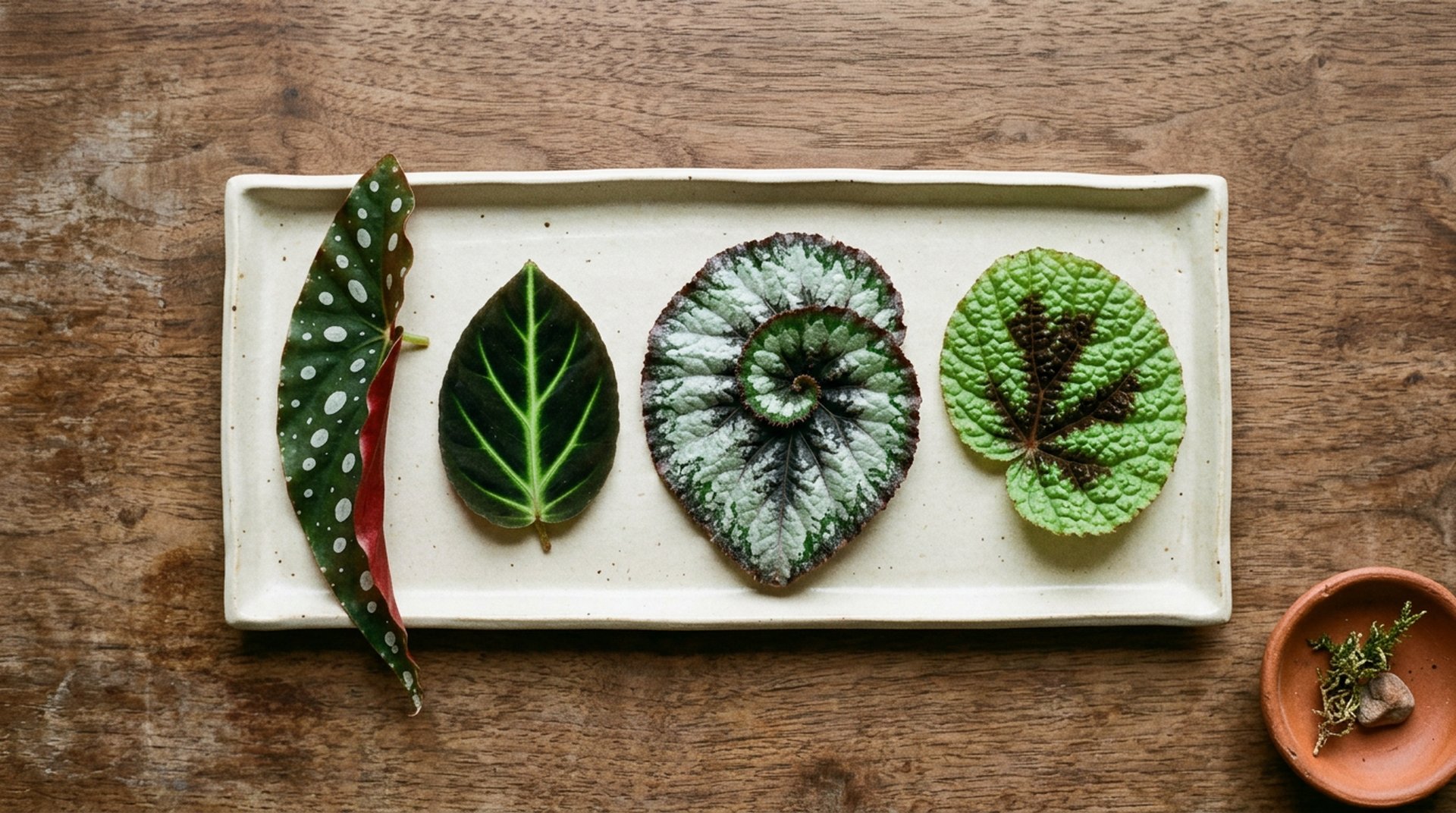
The first thing to look for, every time, is the asymmetry. Almost every species in the genus produces leaves with one lobe noticeably bigger than the other. The midrib runs off-center. The base of the leaf is oblique. It's so consistent across the genus that botanists use it as a diagnostic feature: if a leaf is bilaterally symmetrical, you're probably not looking at a begonia.
Why? The current best explanation centers on light capture. In a dappled forest understory, an asymmetric leaf intercepts oblique light better than a balanced one. It reduces self-shading and grabs more of the brief sunflecks that filter through the canopy. The asymmetry isn't decoration. It's a strategy for living on the floor of a tropical forest.
The Leaf in Cross-Section
Slice a begonia leaf and you'll find four functional layers stacked together. From the top down: the upper epidermis, the palisade mesophyll, the spongy mesophyll, the lower epidermis. The boring textbook list. What matters is what each one does.
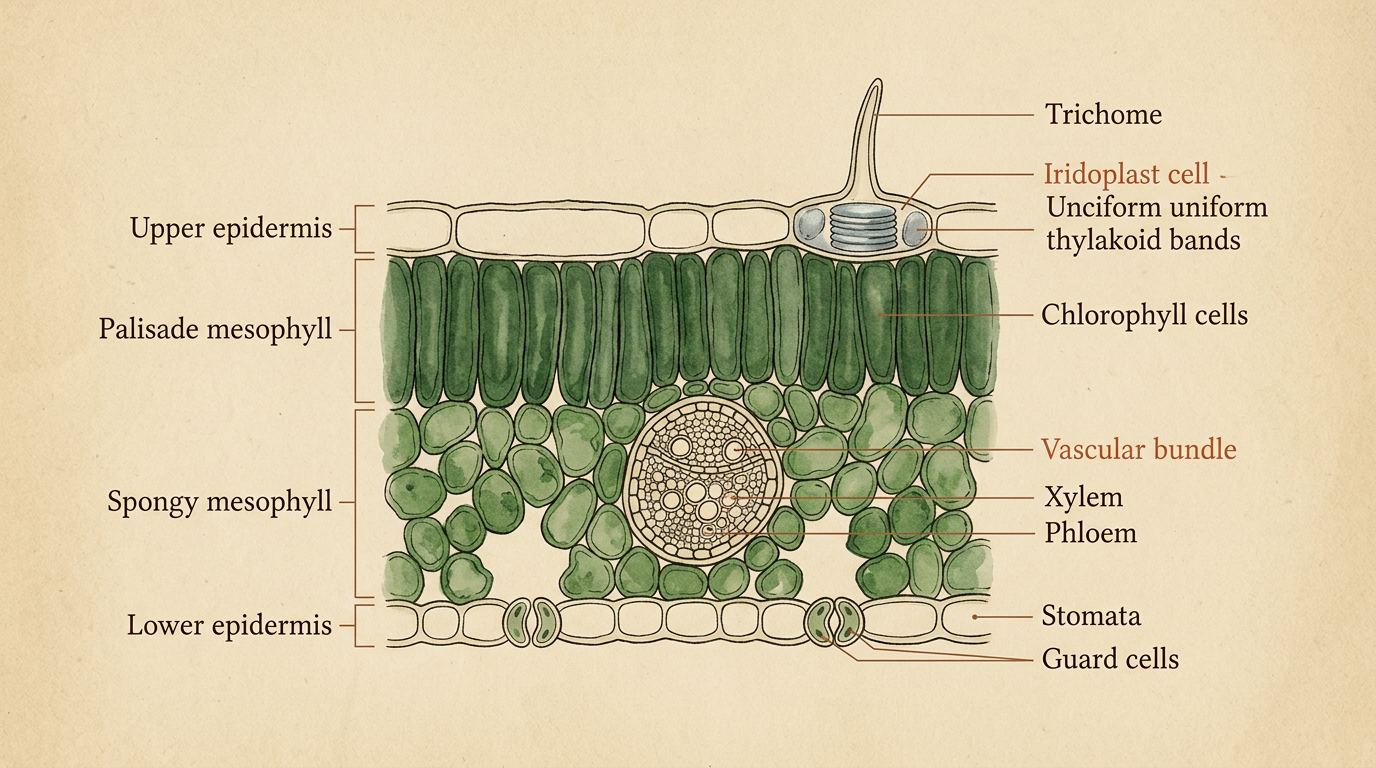
The upper epidermis is one cell thick, and in many begonias it's where the action lives. Specialized chloroplasts called iridoplasts sit in this layer in some species. That's unusual; most plants do their photosynthesis in the mesophyll below. The epidermis also carries the trichomes, which are the hairs you see on species like Begonia ferox and B. listada. Trichomes pull triple duty: cutting water loss, deterring insects, and trapping a thin pocket of humid air right at the leaf surface.
The palisade mesophyll sits directly under the upper epidermis. This is where most photosynthesis happens for most plants. In begonias, which are shade-adapted, the layer is thinner and looser than in sun plants. Diffuse low-light environments don't reward dense palisade tissue.
The spongy mesophyll is more loosely packed, full of air spaces, and it's the gas-exchange floor of the leaf. CO₂ in, water vapor and oxygen out, all moving through the air pockets between cells. Vascular bundles thread through both mesophyll layers, delivering water from the roots and carrying sugars away.
The lower epidermis is mostly stomata. Almost every gas exchange happens through this surface. We'll come back to this in a minute, because it's why your humidifier matters more than any other piece of begonia equipment you own.
The Iridoplast: A Photonic Crystal in a Leaf Cell
This is the part that makes Rex begonias what they are.
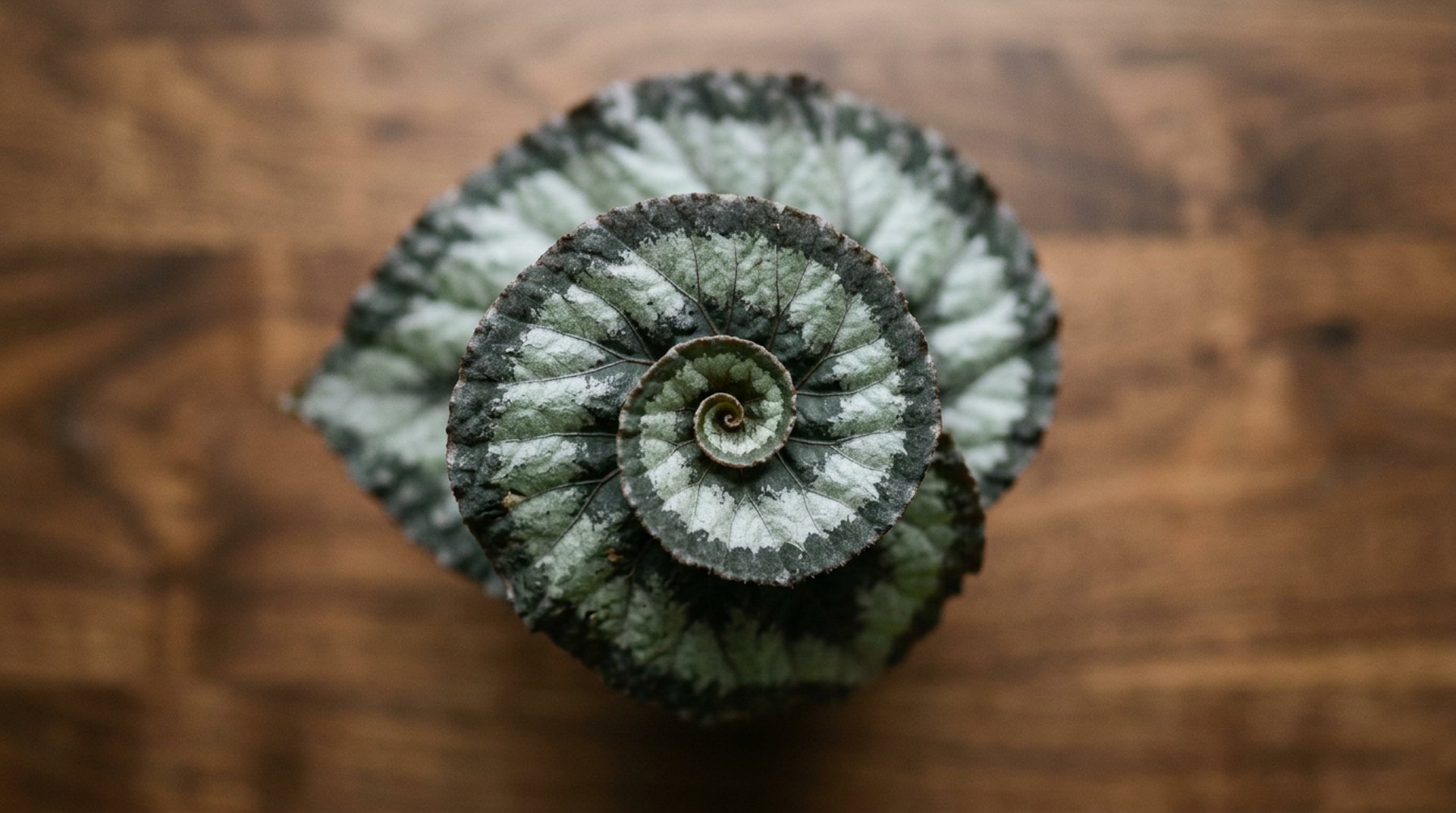
The metallic, iridescent, silver-and-burgundy surfaces that distinguish Rex hybrids and many wild rhizomatous begonias come from a structure called the iridoplast. It's a modified chloroplast, specific to the upper epidermal cells of certain shade-dwelling begonias.
A normal chloroplast contains thylakoid membranes stacked irregularly inside it. An iridoplast stacks them with extreme regularity: uniform thylakoid layers separated by uniform gaps. That regular spacing turns the iridoplast into a one-dimensional photonic crystal. Light hitting the structure interferes with itself the way light interferes on a soap bubble or an oil slick. The metallic shimmer isn't pigment. It's physics.
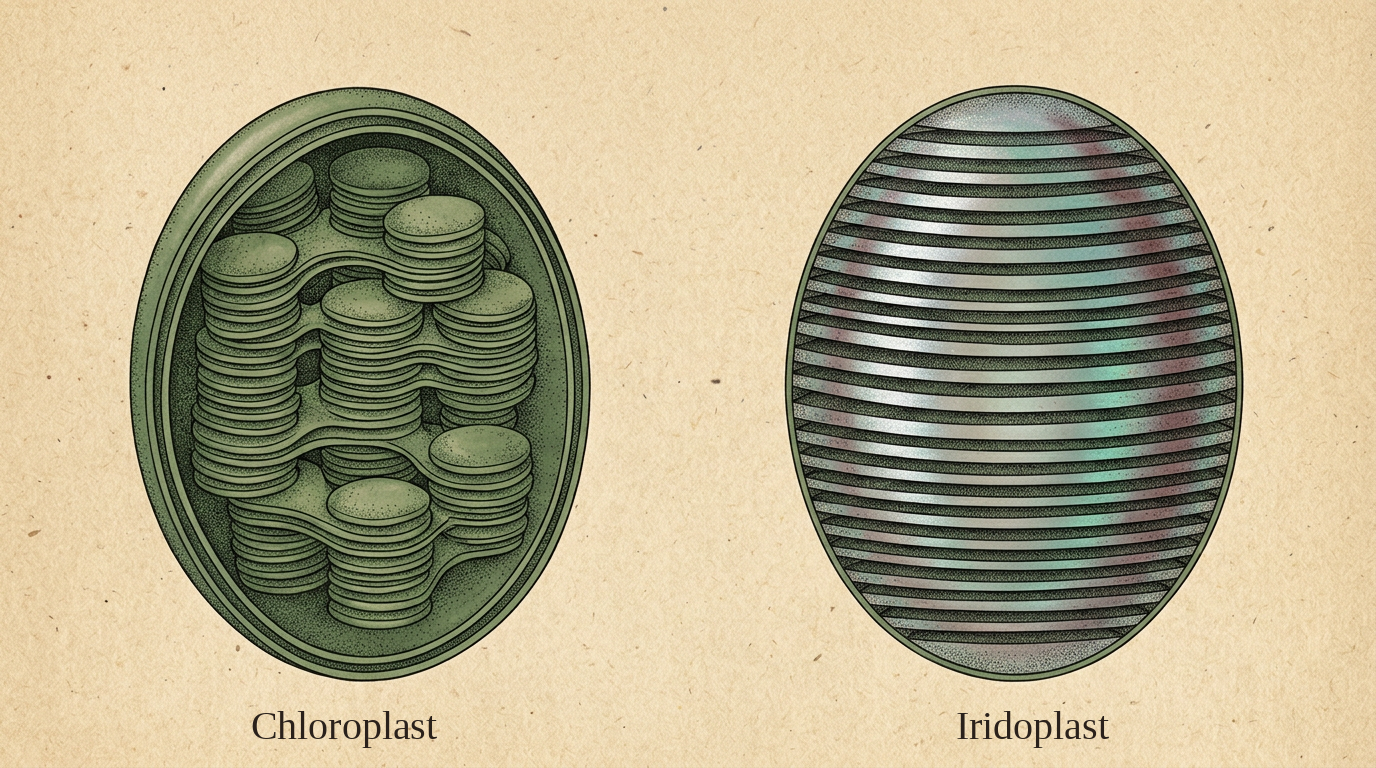
In wild begonias the iridescence usually reads blue or blue-green, because the spacing of the thylakoids preferentially reflects those wavelengths. In modern Rex hybrids, the same optical principle now produces silvers, deep purples, crimsons, and bronze tones that change as you walk past them, the result of generations of breeding for variation in the upper-epidermal expression.
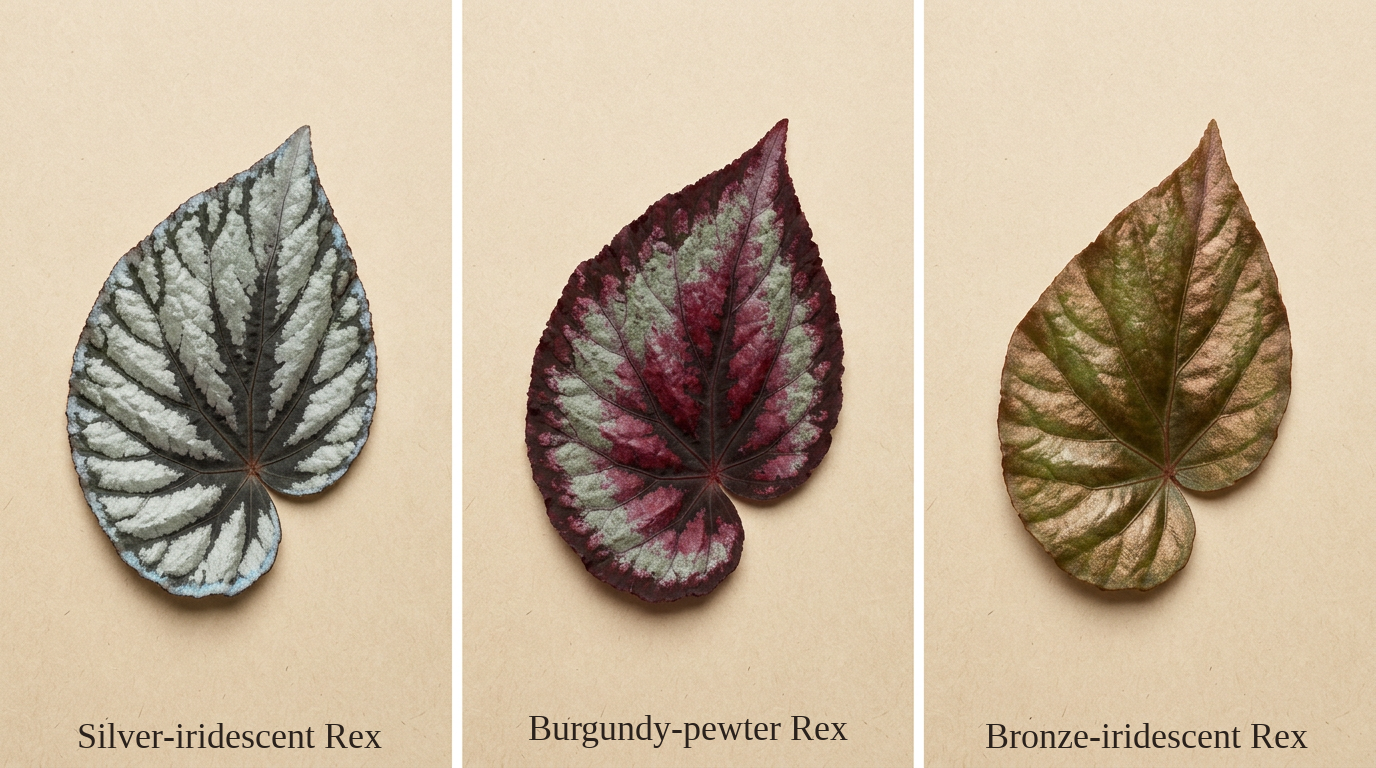
The visual effect is the famous part. The functional part is more interesting. A 2016 paper in Nature Plants (Jacobs et al.) showed that iridoplasts in shade-dwelling begonias do real photosynthetic work: they capture more light at the green wavelengths that dominate deep shade, and they boost quantum yield by 5 to 10% under low light. The shimmer the human eye sees is a side effect. The actual job of the iridoplast is energy.
Practical consequence: the metallic look fades when you give a Rex too much light. The iridoplast is built for shade. Move it into a brighter window and the cellular architecture changes, the photonic effect dampens, and the silver flattens into matte green. If your Rex looks dull, it's almost always too bright before it's anything else.
Stomata, Humidity, and What Your Hygrometer Is Measuring
Stomata are the microscopic pores that handle gas exchange. In begonias, almost all of them sit on the underside of the leaf, and the family arranges them in a spiral pattern called helicocytic. That's a diagnostic feature, but it isn't why it matters to you.
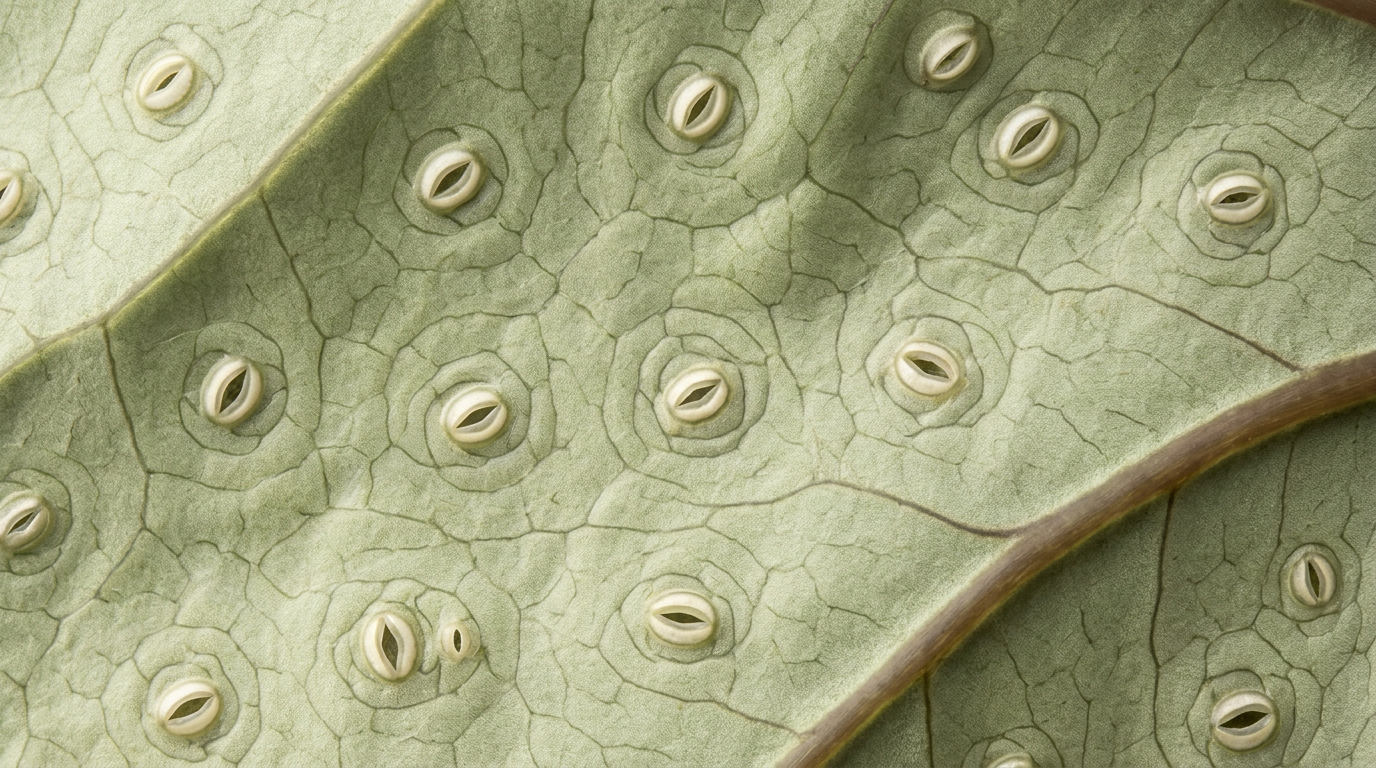
It matters because of transpiration. Stomata open to let CO₂ in, and water vapor leaves through the same pores. The lower the surrounding humidity, the steeper the gradient between the wet leaf interior and the dry air outside, and the faster water moves from leaf to room. Begonias have large, thin, mostly waxless leaves. They lose water fast.
That's the whole reason the humidity rule is the rule. High humidity doesn't reduce how often you water. It reduces the rate at which water evaporates out of the leaf surface, which keeps the plant in hydraulic balance at whatever watering frequency you're already on. When growers say a Rex needs 60% humidity, what they mean is: below 60%, the leaves lose water faster than the roots can deliver it, and the plant goes into deficit. The browning margins, the curled edges, the wilted look that doesn't recover from a deep water. That's the leaf running dry while the substrate is still wet.
Cane Stems: The Bamboo of the Genus
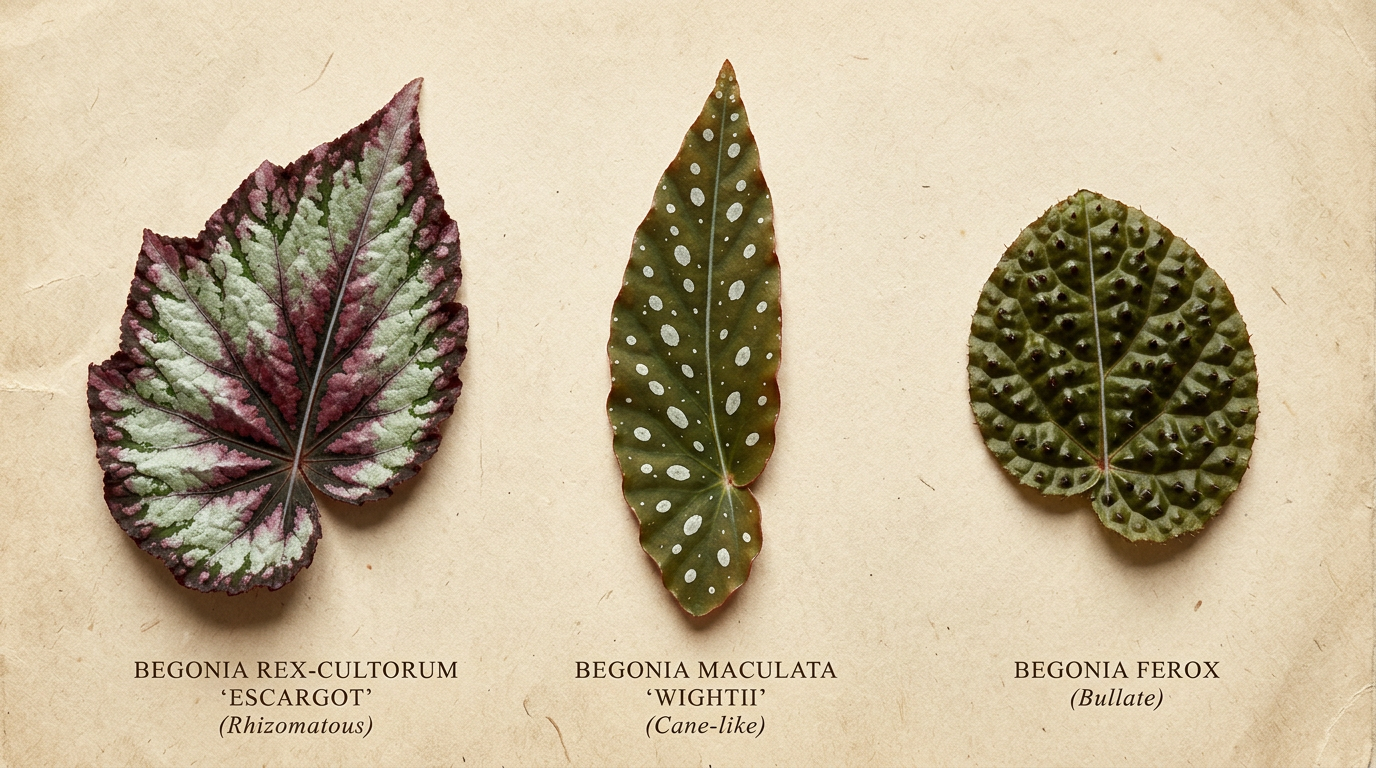
Cane begonias have erect, segmented, fibrous stems that look anatomically a lot like bamboo. Clear nodes, internodes between them, vascular bundles running through a central pith. They're not truly woody, but mature canes are fibrous enough to support stems three to six feet tall.
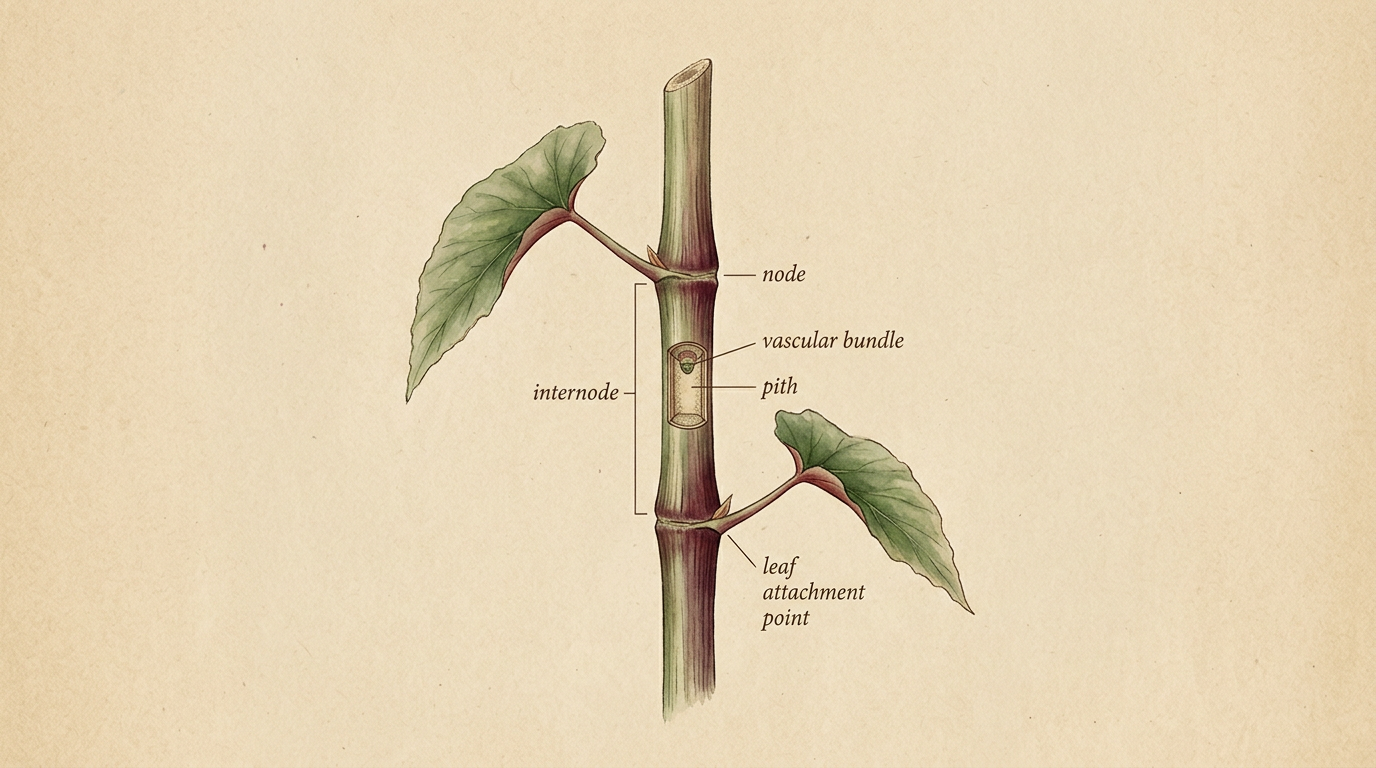
Begonia maculata, B. coccinea, and B. brevirimosa subsp. exotica are all canes. The architecture lets the asymmetric leaves alternate up the stem in a way that maximizes light interception. That's the angel-wing arrangement. It's also why pinching matters so much for these plants. A cane begonia branches below the cut, but only if you cut. Left alone it builds one or two long stems that eventually snap under their own leaf load.
Rhizomes: The Rule That Breaks More Begonias Than Light or Water
The rhizome is the defining structure of the rhizomatous and Rex groups. It's a modified stem, not a root, and it grows horizontally at or just below the substrate surface. Leaves come up from the rhizome's nodes, roots come down from its underside.
The internal anatomy explains the care rules. Inside the rhizome is a dense vascular cylinder wrapped in starch-rich parenchyma. That's the energy reserve. A rhizomatous begonia can survive a missed watering or a brief dry spell better than a cane begonia can, because the rhizome has a buffer. The buffer is also why rhizomatous begonias bounce back from hard cutbacks: the energy is already in the bank.
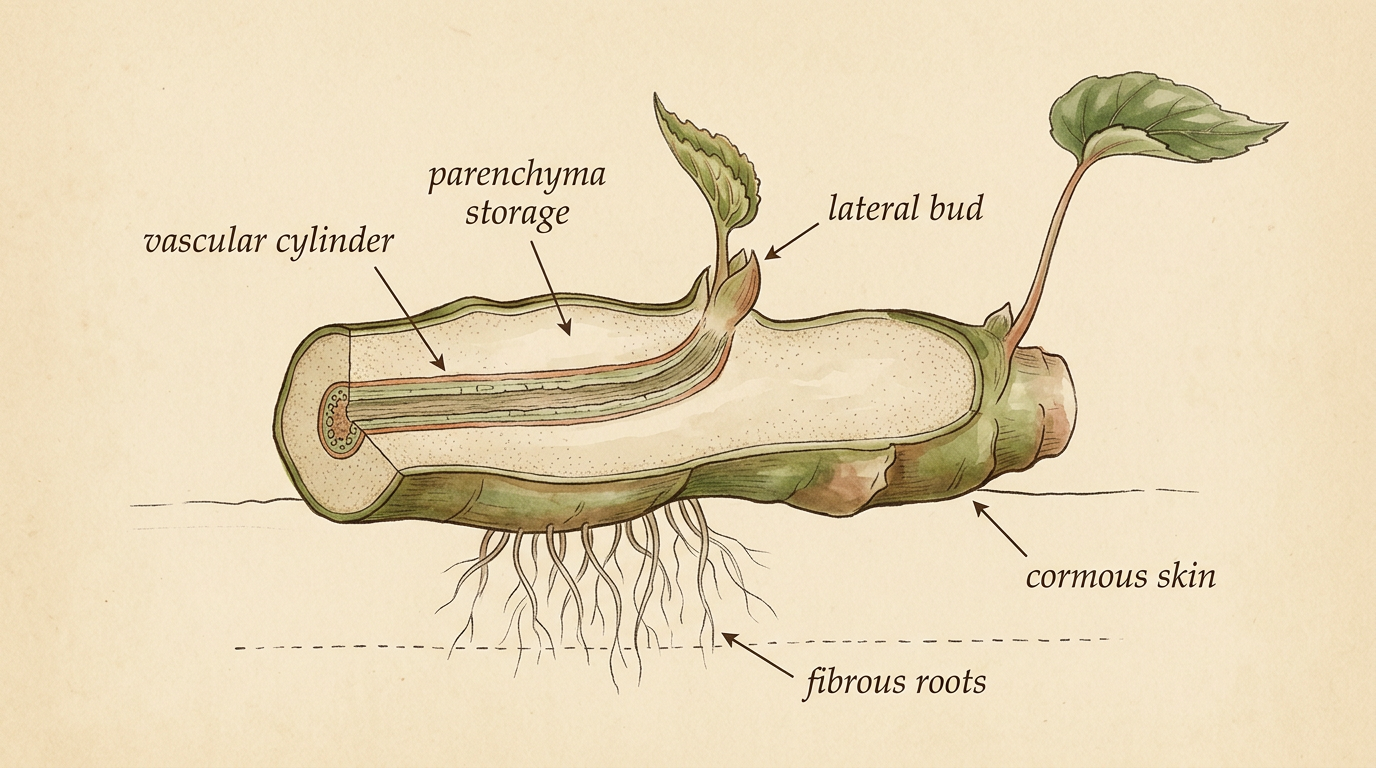
But the rhizome is aerobic. It needs oxygen in the substrate around it to function. Bury it under compacted soil or hold it in waterlogged substrate and the oxygen drops to zero, the cells suffocate, and rot starts. This is the single biggest killer of Rex begonias in cultivation, and it's almost always misdiagnosed as overwatering.
Overwatering is part of it. The deeper problem is substrate. Even daily watering won't rot a rhizome sitting on top of a chunky, well-aerated mix in a shallow pot, because the air keeps moving around it. The same plant in a deep pot of dense compost rots in a week. The traditional advice (shallow pots, well-aerated substrate, rhizome at or near the surface) is anatomical, not aesthetic.
The Harmony's Rex hybrids on my upper shelf have rotted exactly twice in five years. Both times it was a deep nursery pot, not the watering. After the second loss I moved every rhizomatous begonia in the collection into shallow azalea pots with a 50% Fluval Stratum, 25% perlite, 25% bark mix and didn't lose another one. The change wasn't watering frequency. It was air around the rhizome.
Tubers and Pachycauls: The Dry-Season Specialists
Tuberous begonias evolved for habitats with a real dry season: the Andean highlands, parts of Africa, the seasonally dry tropics. The tuber is a swollen stem storage organ that holds enough water and starch to carry the plant through dormancy. It's discrete, rounded, and persists across years. The aerial growth dies back; the tuber waits.
Pachycauls take a related strategy with thicker, swollen stem bases that store water. Different shape, similar logic. If you grow a tuberous begonia and the top dies off in winter, the plant isn't dead — it's doing its job. Stop watering, store the pot somewhere cool and dry, and bring it back in spring.
Roots: Shallow, Fibrous, Fragile
Every begonia in cultivation has a fibrous root system. Fine, branching, no taproot. The architecture matches the genus's habitat: shallow organic forest soils, where roots spread laterally through leaf litter and humus rather than driving down through mineral soil.
The practical consequence is that begonia roots live in the top inch or two of substrate, where compaction, salt buildup, and waterlogging hit hardest and fastest. The standard advice to use well-draining substrates isn't aesthetic preference. It's a response to a root system that evolved to grow through the duff layer of a tropical forest, not through compost.
In rhizomatous and Rex types, roots emerge from the underside of the rhizome and stay in the surface layer. In cane types, roots form from any stem node that touches moist substrate, which is why cuttings root so easily. In tuberous types, the roots grow fresh each season and die back with the leaves.
Flowers and Seeds: Monoecious, Microscopic, No Blue
Begonias are monoecious. Each plant produces both male and female flowers on the same individual but in separate structures. Male flowers carry two to four tepals and a cluster of stamens. Female flowers carry five tepals and an inferior ovary that develops three winged lobes. The winged ovary persists into the fruit, which is a dry capsule full of microscopic seeds.
The seeds are some of the smallest produced by any flowering plant. Under a millimeter each, hundreds or thousands per capsule. They have no parachutes, no hooks, no obvious dispersal kit. They're just light enough that wind and water can carry them surprising distances. In cultivation they need very high humidity, bright diffuse light, and substrate so fine you can barely call it a covering.
One curiosity worth knowing: begonia flowers come in white, pink, red, orange, and yellow. Never blue. The genus appears to lack the biosynthetic machinery for blue anthocyanins, though the genetics of why haven't been worked out the way they have for chrysanthemums or roses. In a group this variable, a constraint that strict is unusual.
The Bullae of Begonia ferox
One anatomical feature deserves its own section because it's anatomy you can watch develop on a plant in your own collection.
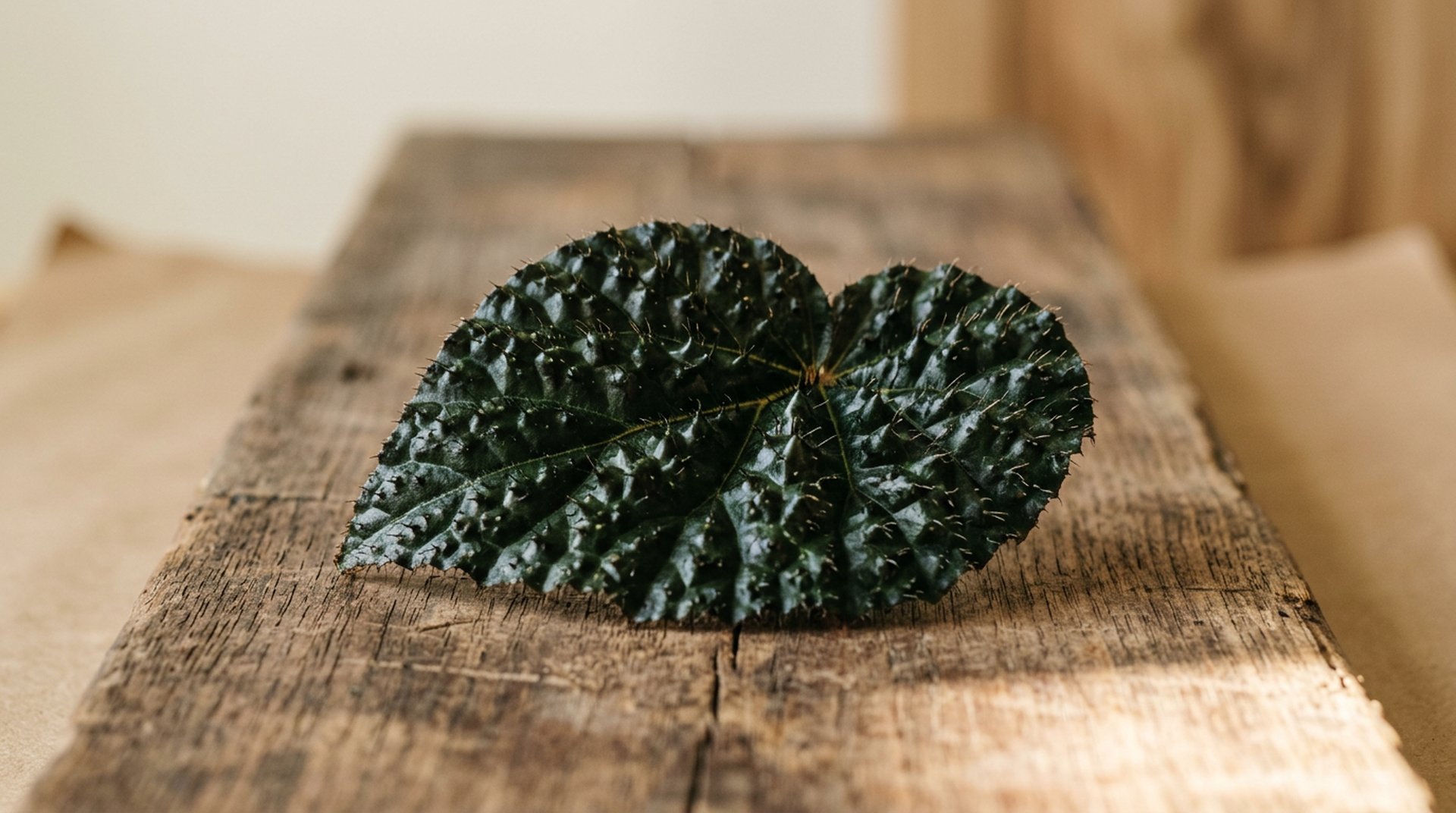
The bullae of Begonia ferox are the rounded, dome-shaped protrusions that cover the upper surface of mature leaves, each one tipped with a dark trichome. They're among the most extreme trichome structures in the genus, and they aren't unique to ferox. B. melanobullata from northern Vietnam (Cao Bang Province) and B. daunhitam from West Kalimantan share them. But ferox probably wears them harder than anything else in the genus.
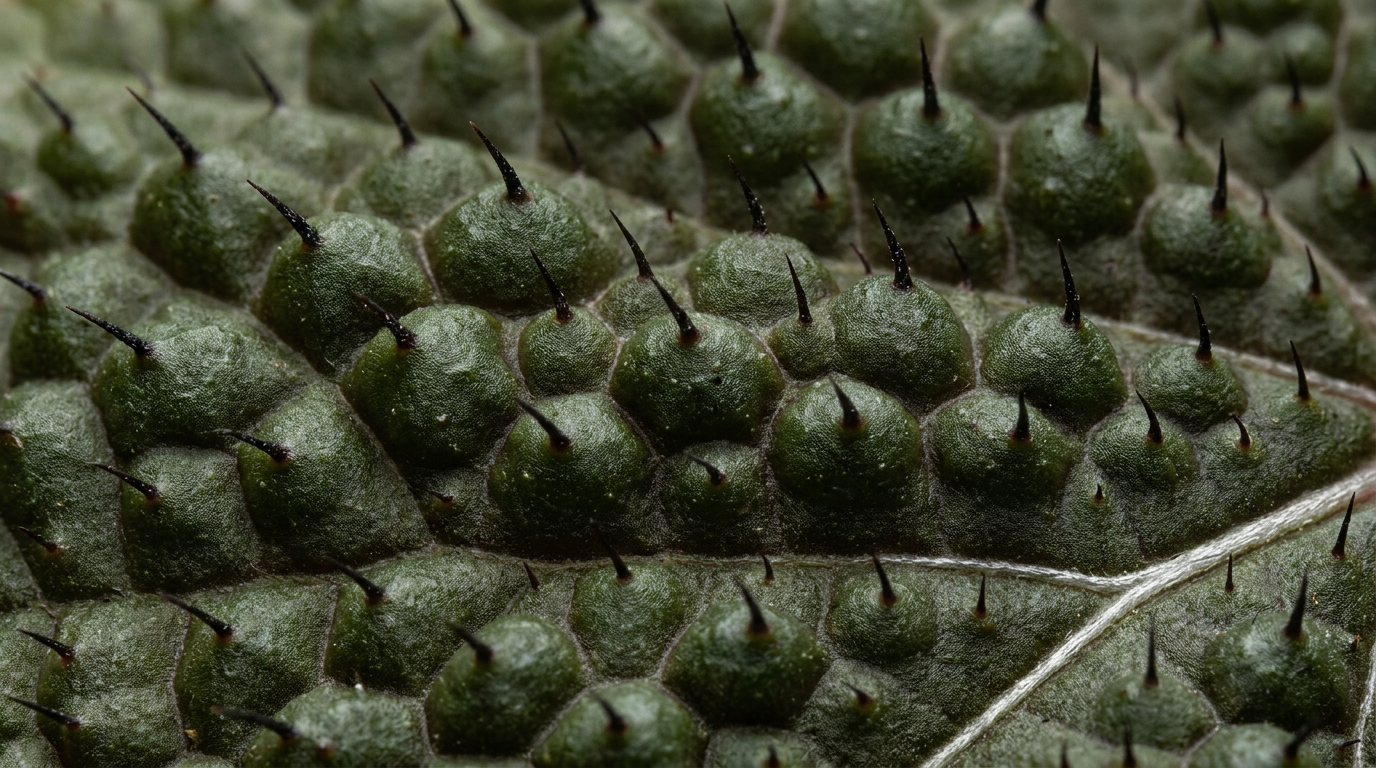
The interesting part: bullae develop progressively. Juvenile leaves are smooth and flat. As a leaf matures, the bullae form and harden, and the armored texture appears. A young plant with smooth leaves isn't an unhealthy plant. It's an immature one. This juvenile-to-adult phase shift is one of the most striking developmental sequences in cultivation, and it rewards patience in a way most houseplants don't.
The function of bullae isn't fully resolved. Best guesses: mechanical defense against herbivores, modulation of the air boundary layer at the leaf surface, alteration of the local light environment. What's certain is that bulla expression is environmentally sensitive. A ferox grown outside its humidity and light comfort range produces smaller, less-defined bullae, or sometimes none at all. The texture is a fitness readout. If your plant's bullae are coming in well, your conditions are right.
The Takeaway
Begonias are forest-understory plants. Thin, large-surfaced leaves. Fibrous or rhizomatous root systems built for shallow organic soils. A light-harvesting apparatus optimized for low-intensity, diffuse illumination. Stomata that drive water loss faster than dry indoor air can sustain. Iridoplasts that work best when light is gentle. Rhizomes that need oxygen as much as water.
Almost every care rule comes back to one of those facts. The collector who reads the Rex shimmer as a photonic crystal will manage their grow space differently from the one who reads it as ornament. The collector who knows the rhizome is aerobic will pick a different pot. The science isn't separate from the practice. It's the practice, just one layer down.
Jacobs, M., Lopez-Garcia, M., Phrathep, O.-P., Lawson, T., Oulton, R., & Whitney, H. M. (2016). Photonic multilayer structure of Begonia chloroplasts enhances photosynthetic efficiency. Nature Plants, 2(11), 16162. doi:10.1038/nplants.2016.162. [PubMed: 27775728]
UF/IFAS Extension. A Beginner's Guide to Begonias: Classification and Diversity. Publication EP581. [link]
Peng, C.-I., Yang, H.-A., Kono, Y., Chung, K.-F., Huang, Y.-S., Wu, W.-H., & Liu, Y. (2013). Novelties in Begonia sect. Coelocentrum: B. longgangensis and B. ferox from limestone areas in Guangxi, China. Botanical Studies, 54, 44. [PMC mirror]
Peng, C.-I., Lin, C.-W., Yang, H.-A., Kono, Y., & Nguyen, H. Q. (2015). Six new species of Begonia (Begoniaceae) from limestone areas in Northern Vietnam. Botanical Studies, 56, 9. [PMC mirror] [Cited for B. melanobullata, type locality Cao Bang Province, Vietnam.]
Wang, W.-G., Randi, A., Wang, C.-X.-L., Shen, J.-Y., Ma, X.-D., Shi, J.-P., Xu, T., & Zhang, S.-Z. (2020). Begonia daunhitam, a new species of Begonia (Begoniaceae) from West Kalimantan, Indonesia. Taiwania, 65(1), 27–32. https://doi.org/10.6165/tai.2020.65.27