A field guide to Begonia ferox. Wild origin, the bullae timeline, light, water, humidity, substrate, and why this plant is more about patience than precision.
About the Species
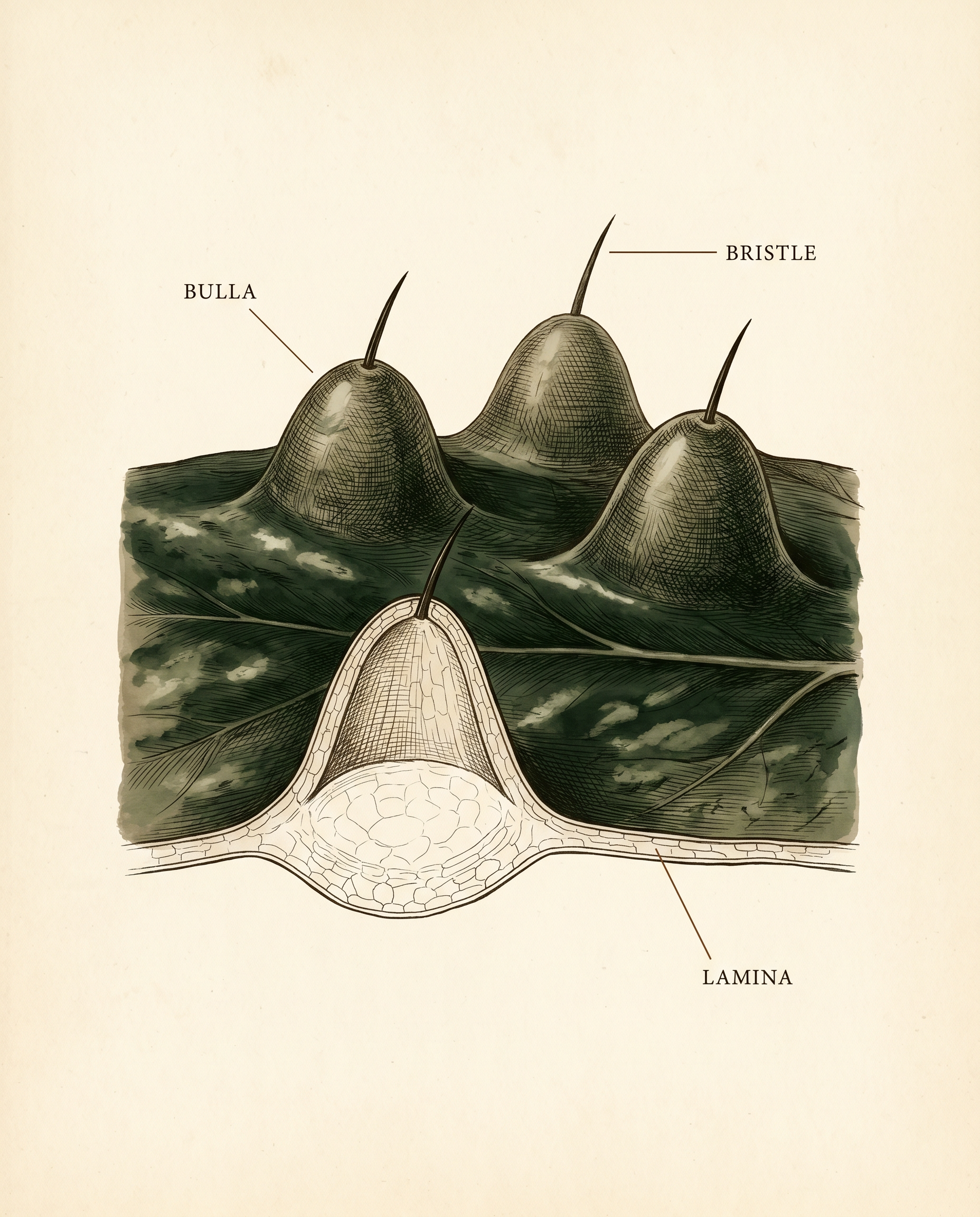
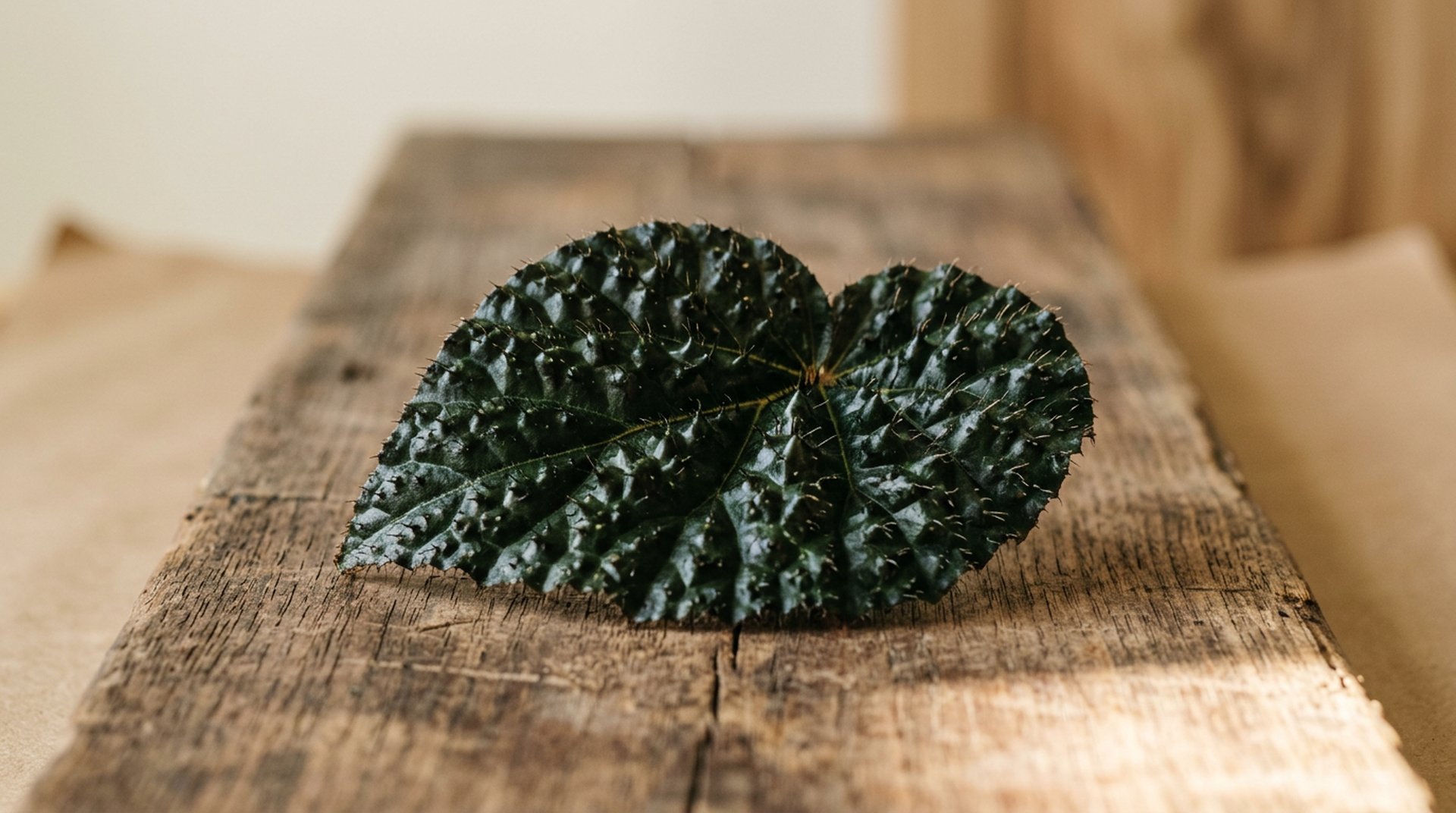
Ferox is unlike anything else in the genus. The leaves grow into something that looks more like the back of an armored insect than a houseplant. Dark green, glossy, studded with rounded conical projections (bullae), each one tipped with a stiff dark hair. The texture isn't decorative. It's the most extreme trichome architecture (trichomes are the fine hairs plants grow on their surfaces) in the genus, and probably in any houseplant most growers will encounter.
The species was described to science in 2013. By 2026 it's still rare in cultivation, still expensive, and still the kind of plant that turns visitors quiet for a second when they notice it on a shelf. Worth every bit of the patience it asks for.
Native Range and Discovery
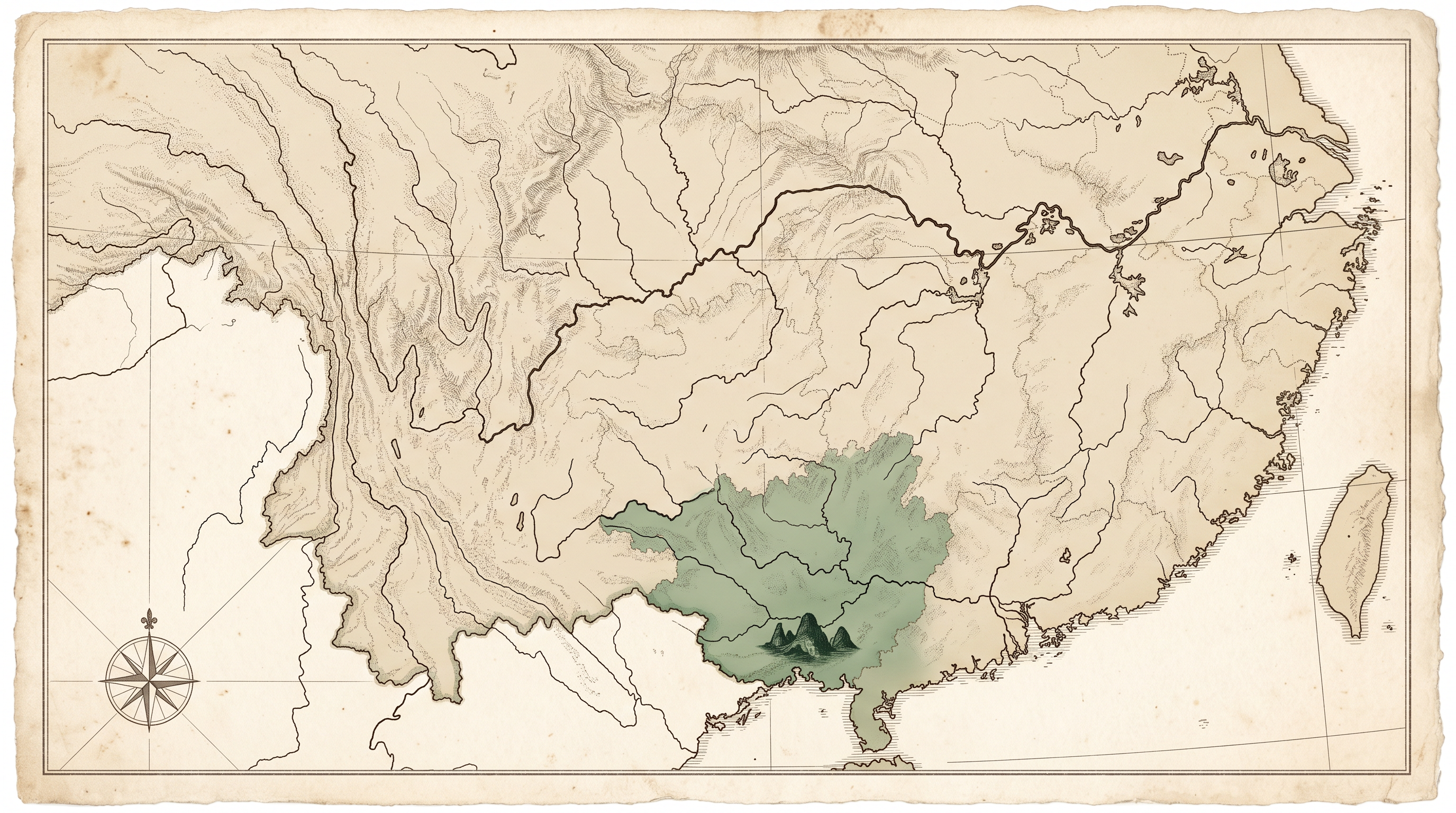
The story starts on April 20, 2011, when botanist Yan Liu, working with Ching-I Peng and colleagues from Academia Sinica in Taipei, surveyed the Guangxi limestone karst (a rugged limestone landscape riddled with crevices, sinkholes, and steep hills) in southwestern China. In the Chunxiu Headwater Forest Nature Reserve, Longzhou County, at about 430 feet of elevation, they found a begonia growing on the forest floor between jagged limestone rocks. The leaves were covered in dark, conical, hair-tipped projections nobody had described before. The holotype (the single specimen that formally anchors a species' name) was deposited at the Herbarium of the Biodiversity Research Center, Academia Sinica. The formal description was published in 2013 in Botanical Studies.
The species name means "fierce" in Latin. A direct reference to the armored leaves.
Ferox belongs to section Coelocentrum, a group of mostly Asian rhizomatous begonias (begonias that grow from a rhizome, a thick stem that creeps along the soil surface instead of standing up like a trunk) centered on the Sino-Vietnamese limestone karst. There are around 47 described species in the section from China alone (Chung et al. 2014), and more get formally described every year as botanists work through the unsurveyed karst hills. Bullate-leaved begonias (those with this raised, blistered leaf surface) are extremely rare in the genus. The only known relatives with comparable surface structures are B. nahangensis from northern Vietnam and B. melanobullata from Cao Bang Province in northern Vietnam (the West Kalimantan bullate species, B. daunhitam, was described separately by Wang et al. 2020). Ferox wears its bullae harder than any of them.
The wild habitat is worth understanding because it explains every cultivation rule. Longgang sits in weathered limestone hills that rise abruptly from flat agricultural land. Each hill is an island of biodiversity. Endemism (species found in one place and nowhere else on Earth) here is extreme. Many species are known from a single hill, sometimes a single valley. Ferox grows as a stoloniferous herb (one that spreads sideways by horizontal runners) directly on or between limestone rocks, in deep shade under evergreen broadleaf forest. The substrate around its roots is mostly accumulated leaf litter caught in the rock crevices, not soil. It's organic, fast-draining, calcium-rich, and constantly humidified by the limestone itself.
Replicating that in a living room is the whole project.
Light: Low to Moderate, Indirect, No Sun
Ferox is a deep-forest floor plant. The leaves run dark green for a reason. There's barely any direct light where the species evolved, and the plant is built for diffuse, low-intensity conditions.
Bright indirect is the ceiling. East window, several feet from the glass, works. Anything brighter starts bleaching the leaf surface and dulling the green. Direct sun, even briefly, scorches the upper leaves and can kill a plant outright if it sits in it for an afternoon.
If you grow under lights, keep the PAR low (PAR is the slice of light a plant actually uses to photosynthesize) and the spectrum on the warmer side. Ferox doesn't reward intensity. It rewards consistency.
Water: Moderate, Consistent, Never Soaking
Water when the surface of the substrate is just dry. Don't let it dry out completely; the rhizome doesn't recover well from desiccation. Don't let it sit wet either; the same rhizome doesn't recover from rot.
Water at the soil line, never on the leaves. Wet bullae trap water against the leaf surface and invite fungal problems faster than they invite anything else. If water lands on a leaf, dab it dry.
Filtered or rainwater is ideal. Ferox isn't as fussy about chlorine and fluoride as some of the more demanding aroids, but the species comes from a calcium-rich karst environment and seems to do better when the water isn't aggressive.
Humidity: 60% Floor, 70%+ Comfortable
This is the rule that breaks most ferox plants in cultivation. Below 60%, the leaves go thin, the bullae dampen, and the plant slowly starves of the conditions it needs. The karst forest floor in Guangxi is one of the most consistently humid environments on the planet. The limestone holds water and releases it slowly into the surrounding air around the clock.
If your home runs in the 30 to 50% range like most do, ferox needs help. A glass enclosure, a planted terrarium, a high-humidity grow tent, or a bathroom that runs warm and damp will all work. A simple humidifier in a closed grow space gets you there. A humidifier in an open living room rarely does.
Above 70%, the bullae develop crisply and the leaves stay glossy. Below 50%, they don't. There isn't much middle ground.
Substrate: Open, Calcium-Aware, Almost Soilless
Ferox doesn't want potting mix. It wants something closer to leaf litter caught in rocks. The recipe that mirrors its native conditions:
- 40% coarse fir bark (medium grade, not fine)
- 25% perlite or pumice
- 15% horticultural charcoal
- 10% fine sphagnum moss
- 10% coir or aged compost
- A pinch of horticultural limestone grit or crushed coral for the calcium
The calcium addition isn't strictly necessary for plants that have been in cultivation for a generation. But it's how the species grew up, and the plants generally look better when you include it. A teaspoon of limestone grit per liter of mix is plenty.
Use a shallow pot. Ferox is rhizomatous, and the rhizome wants to spread laterally with air around it. A deep pot just holds water near roots that don't go that deep anyway.
Temperature
65 to 80°F (18 to 27°C) is the comfort range. Brief dips into the high 50s are fine. Sustained cold below 55°F (13°C) damages the leaves; below 50°F (10°C) the plant starts to fail. Heating vents and cold window drafts both burn leaf margins fast.
Ferox doesn't have a true dormancy in cultivation, but growth slows in winter. Don't push it with extra fertilizer or warmer conditions to keep it going. Let the plant follow its rhythm.
The Bullae Develop With Time
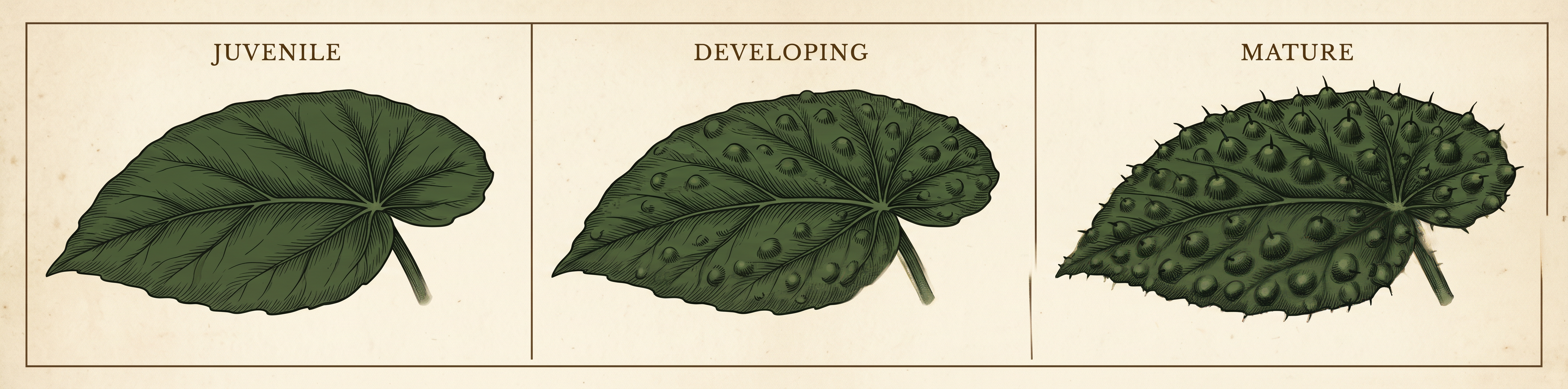
Here's the part to manage your expectations around: a young ferox doesn't look like the photos.
Juvenile leaves on a young plant are smooth, or the bullae are barely visible bumps. The dramatic armored texture only appears as the leaf matures. A small plant with mostly flat leaves isn't an unhealthy plant or a misidentified plant. It's an immature one. The texture comes in over weeks and months as the leaf hardens off.
This developmental sequence is one of the most rewarding things about growing the species. There's always a leaf at some stage of becoming. The progression from smooth juvenile to fully bullate adult is part of what you're paying for, and it's part of what makes the plant feel like a long conversation rather than a static specimen.
Bullae expression is also a fitness readout. Plants grown outside their humidity and light range produce smaller, less defined bullae, or sometimes none at all. If your ferox's new leaves are coming in with the texture you expected, your conditions are right. If they're flat, raise the humidity first, then check the light.
I keep two ferox specimens at different stages, both in shallow azalea pots in a sealed grow cabinet at 70% humidity. The older one is fully bullate now, with hair-tipped cones almost half an inch tall. The younger one is mid-transition: the upper leaves are just starting to dome, while the lower leaves are still mostly smooth. Watching the texture come in on a single leaf over six weeks is the kind of thing that makes the rest of the rare-plant cost feel reasonable.
Reading Ferox's Moods
- Smooth new leaves on a mature plant — humidity is dropping below threshold. Check your hygrometer. The leaf already grown won't change, but the next one will tell you whether you fixed it.
- Browning leaf margins — air is too dry, or a heat vent is hitting the plant. Move it or add humidity.
- Soft mushy stem at the rhizome — rot. Pull the plant, cut to clean tissue, dust with cinnamon or a fungicide, and replant in fresh dry mix. Withhold water for a week.
- Pale or bleached upper leaves — too much light. Move it back from the window or dim the grow light.
- Slow growth in winter — normal. Don't fertilize, don't repot, don't push.
- Tiny new leaves replacing larger ones — the plant is stressed and shrinking back. Check substrate, humidity, and watering rhythm in that order.
Propagation: Rhizome Division, Slow
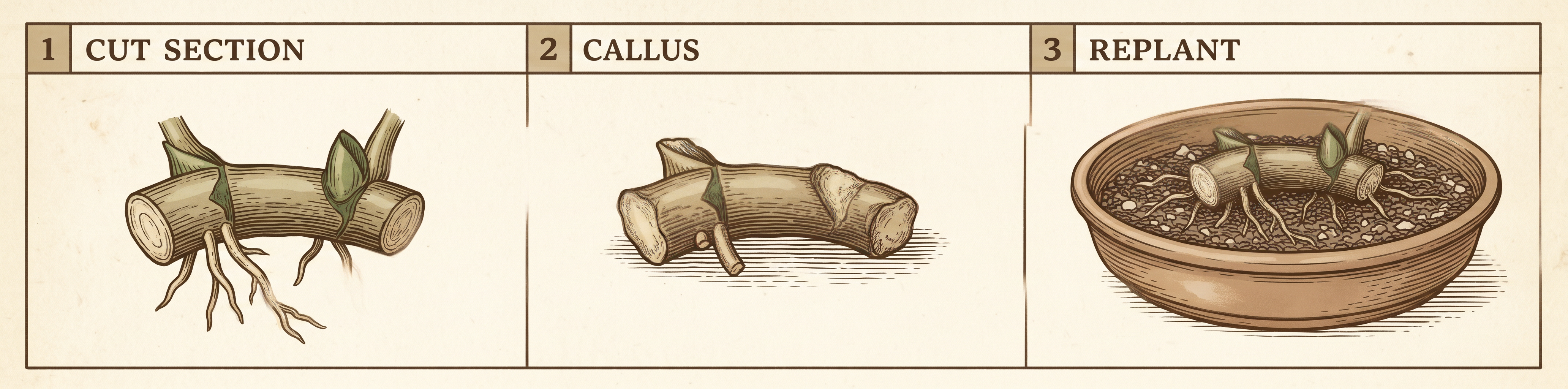
Ferox propagates through rhizome division. Take a section of rhizome with at least two healthy nodes and several roots, let the cut surfaces callus (seal over with a protective layer) for a day in dry air, then plant in the same fast-draining mix you grew the parent in. Keep it at 70%+ humidity and warm.
Leaf cuttings work in some begonia species but are unreliable here. Stem cuttings aren't applicable; ferox doesn't have canes. Tissue culture is how the species made it into wider cultivation, but that's a lab process, not a kitchen-counter one.
Plan for slow. A divided rhizome may take a full season to establish before it puts out a new mature leaf with full bullae. This isn't a plant you propagate to share at scale.
A note for pet households: Begonia is mildly toxic to dogs, cats, and humans if ingested. The toxic principle is soluble calcium oxalates, concentrated most heavily in the underground parts (rhizomes and tubers). Clinical signs include vomiting and salivation. Keep out of reach of pets that chew, especially during repotting when the rhizome is exposed (ASPCA Animal Poison Control Center).
The Takeaway
Ferox is one of the most distinctive begonias in cultivation, and one of the most demanding. The rules: low light, consistent moderate watering, humidity above 60%, an almost soilless substrate, a shallow pot, and patience while the bullae develop. Get those right and the plant rewards you with the most architecturally extreme leaves in the genus, slowly, over years.
It's not a houseplant in the casual sense. It's a long project, and a beautiful one.
Peng, C.-I., Yang, H.-A., Kono, Y., Chung, K.-F., Huang, Y.-S., Wu, W.-H., & Liu, Y. (2013). Novelties in Begonia sect. Coelocentrum: B. longgangensis and B. ferox from limestone areas in Guangxi, China. Botanical Studies, 54, 44. [PMC mirror]
Chung, K.-F., Leong, W.-C., Rubite, R. R., Repin, R., Kiew, R., Liu, Y., & Peng, C.-I. (2014). Phylogenetic analyses of Begonia sect. Coelocentrum and allied limestone species of China shed light on the evolution of Sino-Vietnamese karst flora. Botanical Studies, 55, 1. [PMC mirror]
Peng, C.-I., Lin, C.-W., Yang, H.-A., Kono, Y., & Nguyen, H. Q. (2015). Six new species of Begonia (Begoniaceae) from limestone areas in Northern Vietnam. Botanical Studies, 56, 9. [PMC mirror] [Cited for B. melanobullata from Cao Bang Province, Vietnam.]
ASPCA Animal Poison Control Center. Toxic and Non-toxic Plants: Begonia. American Society for the Prevention of Cruelty to Animals (aspca.org).