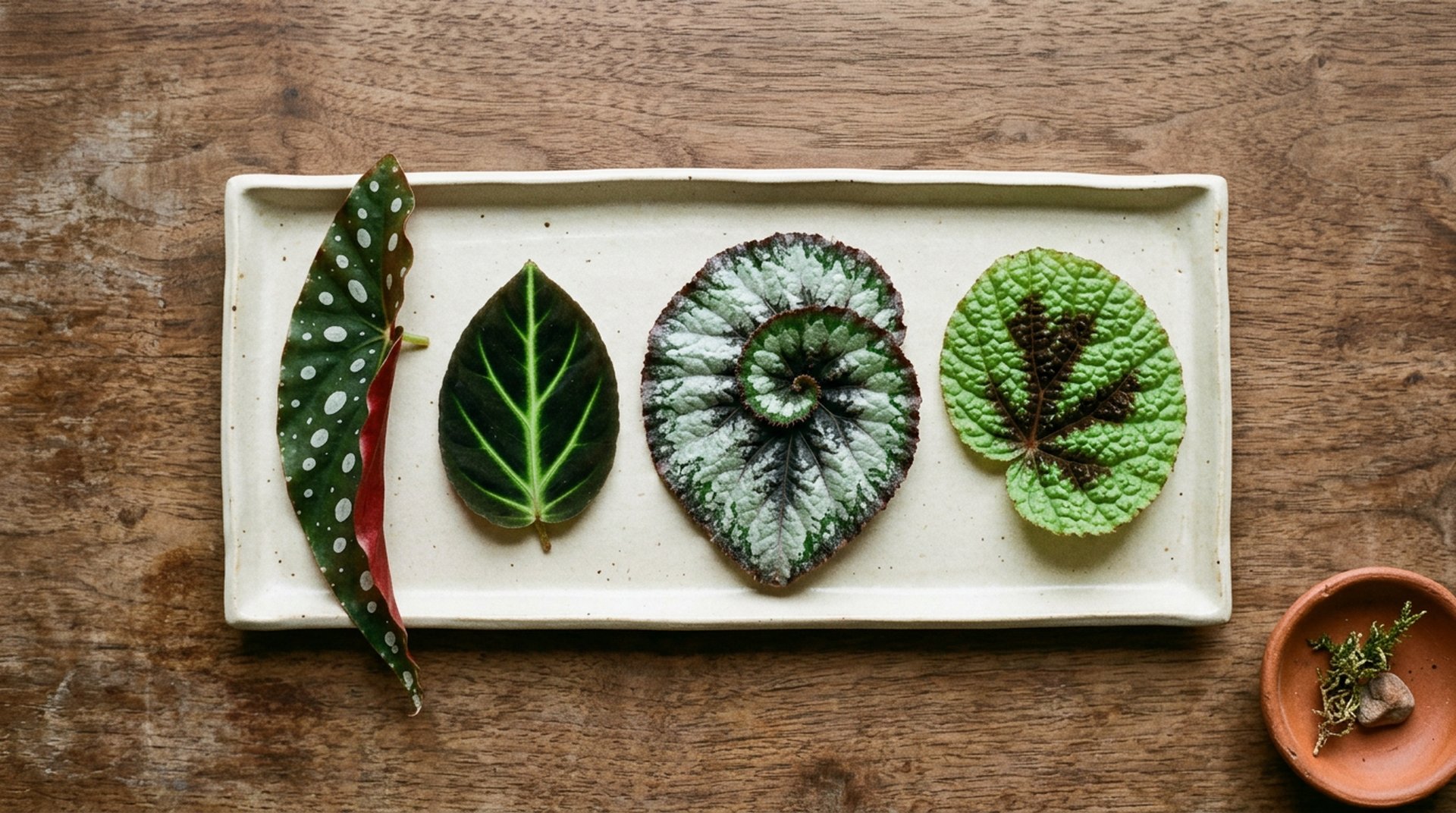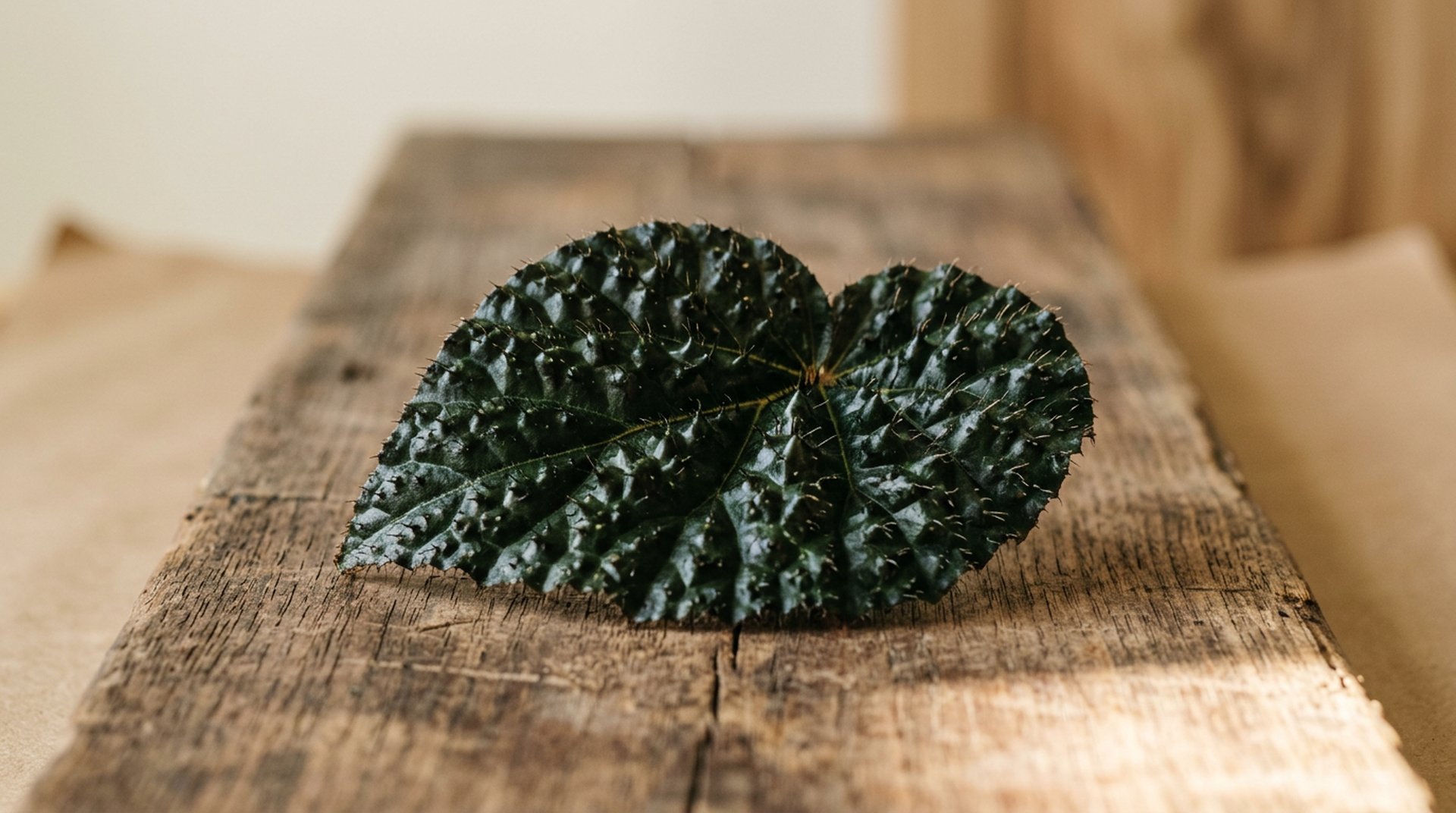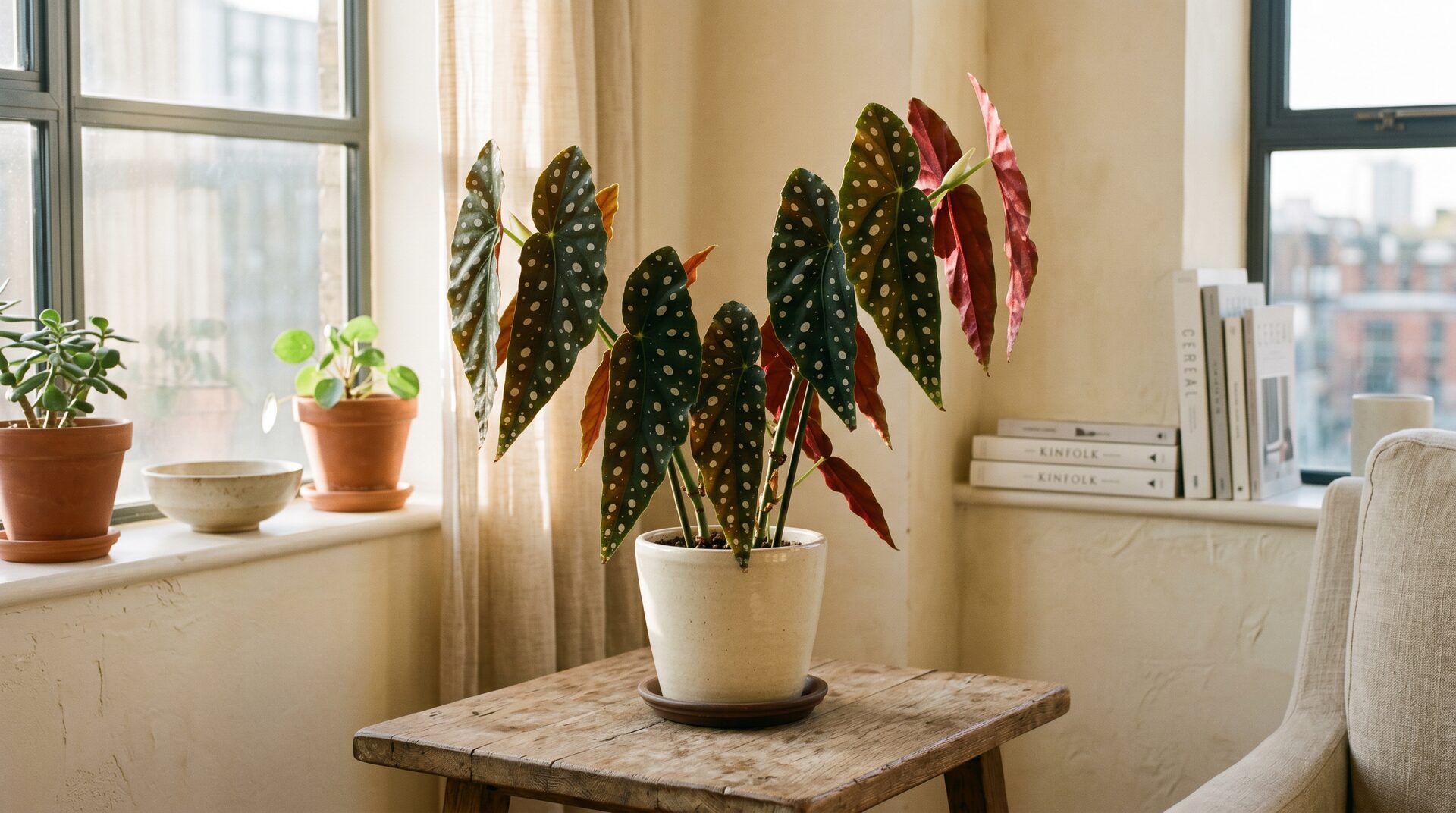
A guide to the Escargot lineage of Rex begonias. The petiole spiral that gives the group its name, the silver-charcoal banding, the cultivars worth tracking down, and the moderate-light rule that separates the showpieces from the disappointments.
About the Lineage
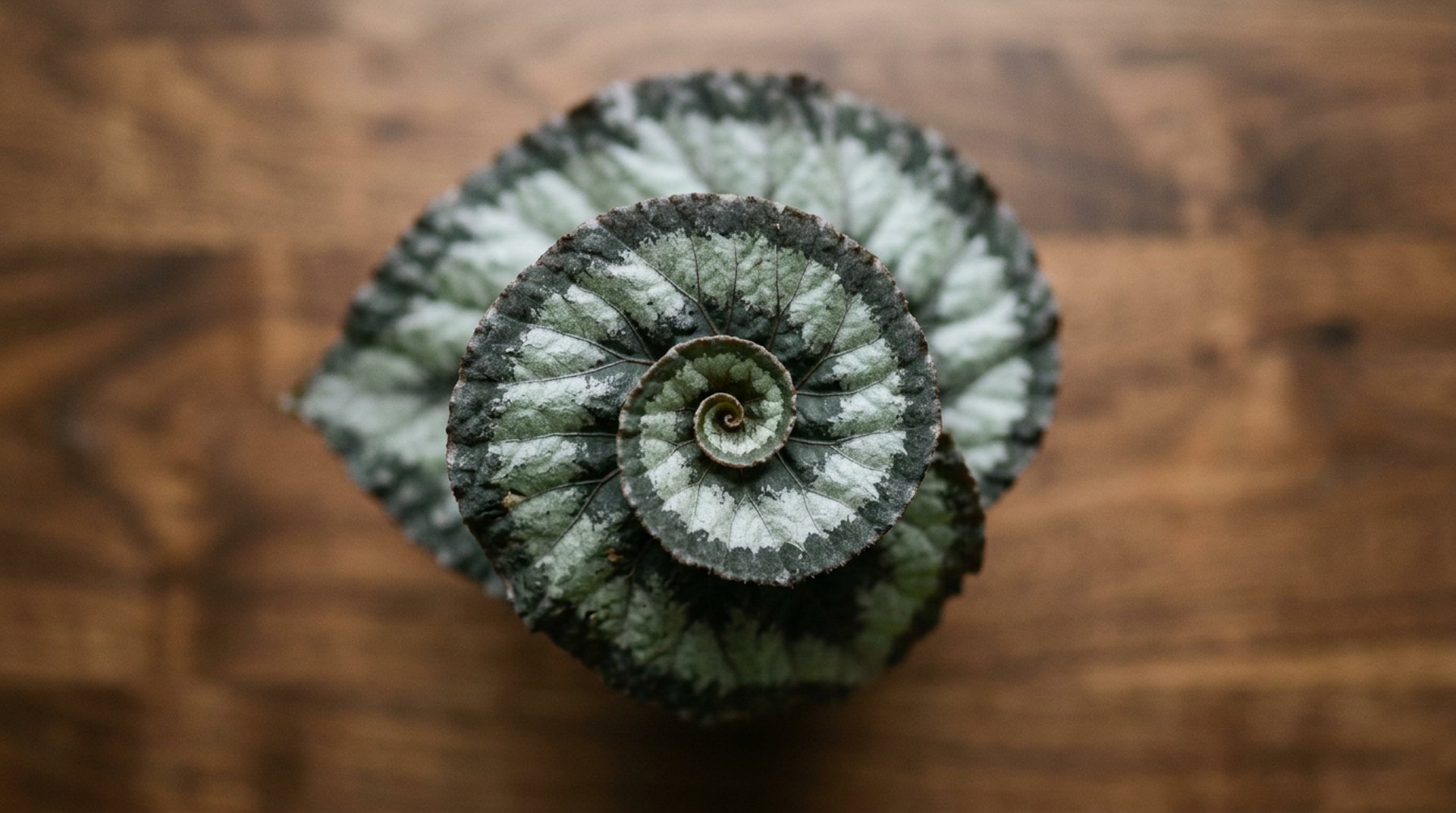
The Escargot Group is the Rex lineage most growers learn the genus through. The defining feature isn't the leaf at all. It's the petiole. Where the stem meets the leaf, the tissue twists into a tight spiral that reads as a snail shell when you look down at the plant from above. Hence escargot. The French were honest about it.
The leaves themselves run wide rosettes of charcoal-and-silver banded tissue, often with a soft, almost matte finish. They're the photogenic centerpiece of any Rex collection, and they're more demanding than the patterned and broadleaf Rex lineages without being as fussy as the metallic ones.
If you're new to Rex begonias and want a representative starting point, this is the lineage to start with. If you've been growing Rexes for years, the Escargot Group is probably already on your shelf.
The Spiral, and Why It Takes Time
The petiole spiral develops as the plant matures. Juvenile leaves on a young Escargot Group plant often emerge with only a hint of the curl. The full snail-shell coil only appears once the rhizome and the leaf have built up enough tissue mass to support the structure.
This catches new growers off guard. People buy a small Rex labeled 'Escargot', see flat-petiole leaves, and assume they got the wrong plant or that something's wrong. Neither is usually true. Give the plant a season of stable conditions and the spiral starts to form on each new leaf.
The spiral also tightens and loosens with conditions. Stable humidity and moderate light produce crisp, well-defined coils. Drought stress, sudden humidity drops, or excessive light can flatten the spiral on new growth. The petiole is, in effect, telling you whether the grow space is doing its job.
Where the Group Comes From
Modern Rex begonias descend mostly from Begonia rex itself, which was introduced from Assam in the 1850s and immediately picked up by European hybridizers. Cross-breeding with a range of rhizomatous species produced the modern Rex world. B. xanthina and (for added height) B. evansiana are among the documented parents, alongside others such as B. diadema, B. dregei, and B. cathayana that contributed cut leaves, smaller size, and velvety texture (Royal Horticultural Society).
The Escargot Group sits closer to the original B. rex parentage than most modern lineages. The rhizome behavior, the matte-finish leaf surface, and the spiral expression itself are all traits that read as old-line Rex breeding. Newer hybrid groups have introduced more iridescence, more pattern complexity, and more vigor, but the spiral is still mostly an Escargot Group trait.
Representative Cultivars
The lineage has dozens of named cultivars. These are the ones worth knowing first.
- 'Escargot': the namesake. Wide silver-and-charcoal banded leaves with a tight petiole spiral. Probably the most photographed Rex begonia in cultivation. Moderate vigor, reasonably forgiving once established.
- 'Merry Christmas': also sold as 'Ruhrtal'. A green-and-red banded version with a similar spiral. Older cultivar, broadly available, slightly slower than 'Escargot'.
- 'Spiral Silver': heavier silver expression, finer banding, smaller leaves. A good companion to 'Escargot' on the same shelf because the texture reads differently in the same light.
- 'Comic Strip': bolder dark-and-silver contrast with a tighter spiral. Slower growth, but the leaves hold their definition longer than the more vigorous Escargot Group cultivars.
- 'Dollar Down': an older spiral-type with a softer band pattern and a more compact rosette. Underrated.
Light: Moderate, Filtered, Steady
This is where the Escargot Group differs most from the metallic Rex lineages. Spiral types want moderate light, not bright. East window, several feet from glass, or a north-facing position with a clear sky works. South or west exposure needs distance and a sheer.
Direct sun bleaches the band pattern within a week. Even bright indirect that's slightly too intense flattens the contrast. The silver dulls toward white, the charcoal lightens to muddy gray, and the leaves stop holding the crisp banded look the lineage is grown for.
Under grow lights, keep par moderate and the photoperiod steady at 12 hours. The lineage rewards consistency more than intensity.
Water: Don't Let Them Dry Out
The Escargot Group has a lower tolerance for underwatering than most Rex lineages. The rhizomes are thinner than the broadleaf or textured types, and they don't carry as much water reserve. Let an Escargot Group plant dry out fully and the leaf margins crisp before the substrate even feels dry to the touch.
The rule: water when the top half-inch of substrate is just dry. Never wait until the whole pot dries down. Filtered or rainwater is ideal. Water at the soil line, never on the leaves. Rex leaves hold water against the surface and develop fungal spots faster than they hold the moisture.
Humidity: 55%+, Stable
Stable matters more than high. The Escargot Group does fine in the 55 to 65% range as long as the number doesn't crash. A house that runs at a steady 55% will grow these better than a house that swings between 70% and 35% with the heating cycle.
If your home dips below 50% in winter, add a humidifier on a hygrostat in the same room. Keep airflow gentle. Stagnant high humidity invites powdery mildew on Rex leaves; moving humid air doesn't.
Substrate: Aerated, Light, Surface-Friendly
Rex rhizomes sit at or just below the substrate surface and need oxygen at the root zone. The mix has to drain fast and stay open.
- 40% quality coir-based or peat-based potting mix
- 25% perlite or pumice
- 15% fine orchid bark
- 10% horticultural charcoal
- 10% worm castings
Use a shallow azalea pot or a wide low container. Deep pots hold water in the lower zone where Rex roots don't reach, and the saturated soil rots the rhizome from underneath. The shape of the pot does more for these plants than most growers realize.
Common Problems
- Petiole spiral flattening on new leaves — usually a humidity drop or a sudden light increase. Stabilize conditions and the next round of leaves should re-coil.
- Charcoal banding fading toward gray — too much light. Move the plant deeper into the room or add a sheer.
- Crispy leaf margins on otherwise healthy growth — underwatering. Tighten the watering schedule and check that the substrate is actually wetting through, not just hydrophobic on the surface.
- White powdery dust on the upper leaf surface — powdery mildew. Pull the affected leaves, improve airflow, dial humidity down a few points, and treat with a 1:9 milk-water spray or a potassium bicarbonate fungicide.
- Soft, mushy rhizome at the base — rot from waterlogged substrate or a too-deep pot. Cut to clean tissue, dust with cinnamon, and replant in fresh dry mix.
- Leaves emerging smaller than the previous round — root stress, usually from compacted substrate or fertilizer salt buildup. Repot with fresh mix and flush the rhizome before replanting.
I lost a 'Merry Christmas' two years ago because it was sitting in too deep a nursery pot near a south-facing window. The rhizome rotted from below while the leaves bleached from above. Same plant, two failure modes at once. The replacement lives on a shelf six feet from the same window, in a wide shallow azalea pot, and it's the most stable spiral on my Rex shelf. The pot shape was the bigger fix. The light position was the easier one.
Propagation: Leaf Cuttings, Famously
The Rex group is the lineage that taught most of us leaf cuttings work. Take a healthy mature leaf, slice the major veins on the underside with a clean blade, and pin the leaf flat against moist substrate or sphagnum moss in a closed container. Bright indirect light, 70 to 75°F (21 to 24°C), high humidity. Plantlets emerge from the cut veins in four to eight weeks.
Wedge cuttings work too. Cut a mature leaf into pie-shaped sections, each containing a major vein, and insert the point of each wedge into moist substrate. Same conditions. Same timeline.
Rhizome division is the cleanest method for an established plant. Cut a section of rhizome with at least two nodes and a few roots, callus the cut for a day, and plant in fresh mix. The Escargot Group divides reliably and recovers fast.
A note for pet households: Begonia is mildly toxic to dogs, cats, and humans if ingested. The toxic principle is soluble calcium oxalates, concentrated most heavily in the underground parts (rhizomes and tubers). Clinical signs include vomiting and salivation. Keep out of reach of pets that chew, especially during repotting when the rhizome is exposed (ASPCA Animal Poison Control Center).
The Takeaway
The Escargot Group is the Rex lineage to start with and the one most worth coming back to. Moderate light, stable humidity, a shallow pot, a substrate that drains, and a watering rhythm that doesn't let the rhizome dry out. The petiole spiral takes time to develop and tightens in good conditions, which makes the plant a slow visual readout on whether your grow space is dialed in.
Get those right and the lineage rewards you with the most photographed Rex begonias for a reason.
American Begonia Society. Rex Cultorum Begonias: Gloriously Gaudy. begonias.org. [Cited for the 1850s introduction of B. rex from Assam.]
Royal Horticultural Society. Begonia Rex Cultorum Group (RHS Plant Trials Bulletin). rhs.org.uk. [Cited for the 1856 Assam introduction and the documented hybrid parentage of the Rex Cultorum group.]
Jacobs, M., Lopez-Garcia, M., Phrathep, O.-P., Lawson, T., Oulton, R., & Whitney, H. M. (2016). Photonic multilayer structure of Begonia chloroplasts enhances photosynthetic efficiency. Nature Plants, 2(11), 16162. doi:10.1038/nplants.2016.162. [PubMed: 27775728] [Cited for the photonic-crystal mechanism behind Rex iridescence.]
ASPCA Animal Poison Control Center. Toxic and Non-toxic Plants: Begonia. American Society for the Prevention of Cruelty to Animals (aspca.org).